

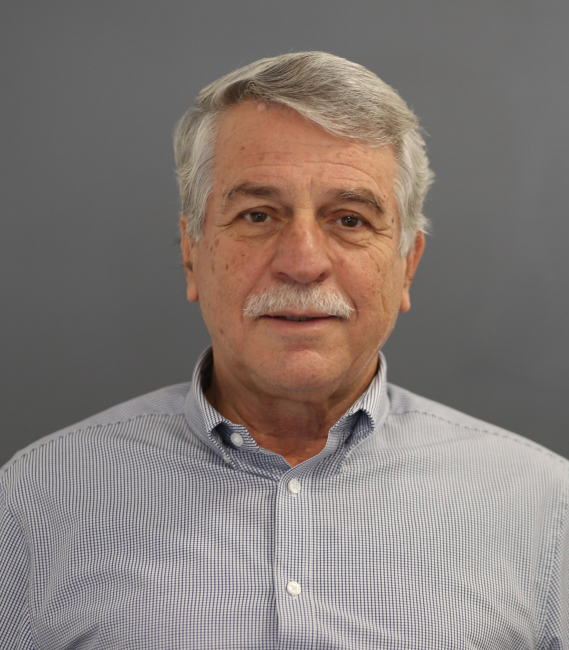
Nick Kylafis
Regular Research Staff, Professor Emeritus, Department of Physics
- Group:Ινστιτούτο Αστροβιολογίας
Nick Kylafis
Regular Research Staff, Professor Emeritus, Department of Physics
✉️ kylafis[at] physics.uoc.gr •
📞 +30-2810-394215 •
Office 214 Physics Building •
expertise: production and transfer of radiation, galactic environments, interstellar medium physics •
Nick Kylafis received his BSc in Physics from the Univ. of Patras and his PhD in Theoretical Astrophysics at the University of Illinois at Urbana-Champaign (USA) in 1978. He was a postdoctoral fellow at Caltech and at the Institute for Advanced Study, Princeton. Then, he was an Assistant Professor at Columbia University before accepting an Assistant Professor position at the University of Crete in 1985. He was promoted to Associate Professor in 1989 and Professor in 1997. He served as Chairman of the Department of Physics from 1999 to 2003, as well as Dean of the School of Sciences from September 2008 to May 2013. During the period 2012-2116 he was a member of the Council of the University of Crete. He retired and was elected Emeritus Professor in 2016. In 2018 he was elected as member of the Council of the European Astronomical Society. He was awarded the 2019 “S. Pichorides Award for Excellence in Academic Teaching” of the Univ. of Crete. In 2019 the Institute of Astrophysics of FORTH established the “Nick Kylafis Lectureship” in his honour.
Research interests :
Theoretical Astrophysics with special interests in production and transfer of radiation, spiral galaxies, and astrophysical MASERs. He has contributed to the so-called Goldreich-Kylafis effect.